
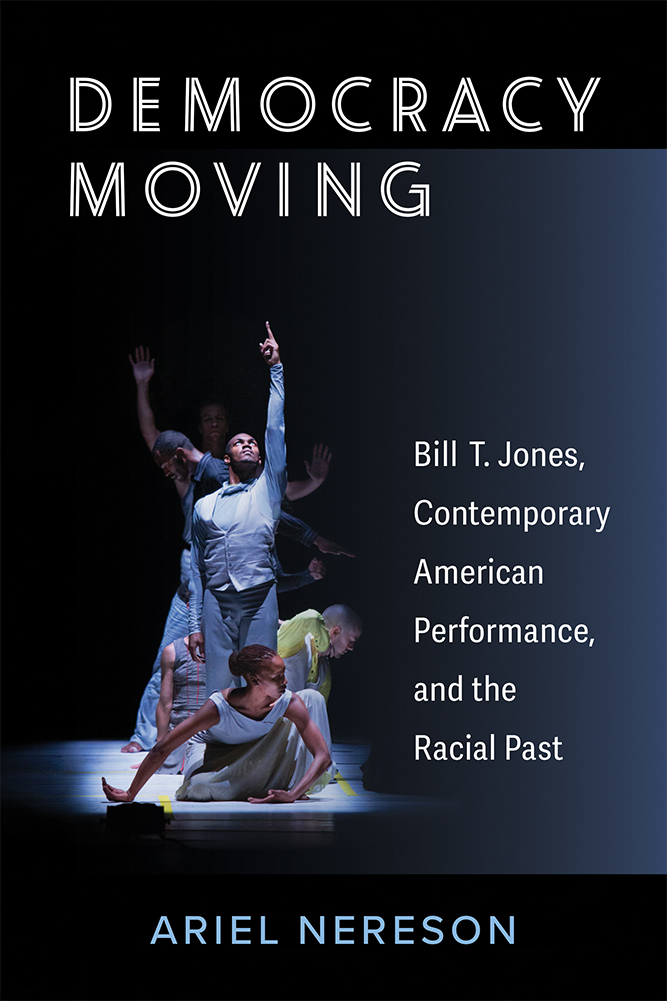
I’m thrilled to share that my book Democracy Moving : Bill T. Jones, Contemporary American Performance, and the Racial Past is now available from the University of Michigan Press!
For a sample of the book’s content and approach, visit the University of Michigan Press’s website for my blog post, “Let’s Make Dances, Not Monuments.”
An essay from this book, “Myself, Dancing: Choreographies of Black Womanhood in US Dance and History,” received the 2022 Vera Mowry Roberts Award from the American Theatre and Drama Society. The essay was published in the December 2021 special issue of Dance Research Journal edited by Nadine George-Graves, “Arms Akimbo: Black Women Choreographing Social Change.”
On the 200th anniversary of Abraham Lincoln’s birth, renowned choreographer and director Bill T. Jones developed three tributes: Serenade/The Proposition, 100 Migrations, and Fondly Do We Hope . . . Fervently Do We Pray. These widely acclaimed dance works incorporated video and audio text from Lincoln’s writings as they examined key moments in his life and his enduring legacy. Democracy Moving explores how these works provided both an occasion and a method by which democracy and history might be reconceived through movement, positioning dance as a form of both history and historiography.
The project addresses how different communities choose to commemorate historical figures, events, and places through art—whether performance, oratory, song, statuary, or portraiture—and in particular, Black US American counter-memorial practices that address histories of slavery. Advancing the theory of oscillation as Black aesthetic praxis, author Ariel Nereson celebrates Bill T. Jones as a public intellectual whose practice has contributed to the project of understanding America’s relationship to its troubled past. The book features materials from Bill T. Jones/Arnie Zane Company’s largely unexplored archive, interviews with artists, and photos that document this critical stage of Jones’s career as it explores how aesthetics, as ideas in action, can imagine more just and equitable social formations.
 Ariel Nereson